Every 24 December, queues form outside KFCs across Japan for chicken that most customers ordered weeks ago. No other country on earth eats fried chicken as its national Christmas dinner — and the whole thing traces back to one marketing campaign in 1974. This is the full story of Kentucky for Christmas.
How it started: Japan, 1970-1974
KFC opened its first Japanese store in 1970, and the early years were hard going — the brand was foreign, the format unfamiliar, and stores needed a reason for Japanese families to visit. The spark, as the often-told version goes, came when staff noticed foreign customers buying fried chicken around Christmas because turkey was nearly impossible to find in Japan. Chicken was the closest available stand-in for a Western Christmas dinner.
KFC Japan turned that observation into strategy. In 1974 it launched a national campaign — Kurisumasu ni wa Kentakkii, "Kentucky for Christmas" — selling fried chicken as the way to celebrate a proper festive meal. The pitch landed in a country where Christmas was a fun, imported occasion with no fixed menu attached. KFC did not displace a tradition; it supplied one where none existed.
The origin story is usually told through Takeshi Okawara, manager of Japan's first KFC and later head of KFC Japan, who is credited with dreaming up the party barrel after hearing foreigners lament the missing turkey. Like most great marketing legends the details have blurred with retelling — versions differ on who said what and when — but the campaign itself, its 1974 date and its slogan are a matter of record. Within a few years, television advertising had done the rest, pairing fried chicken with images of family Christmas warmth until the association simply became true.
The party barrel
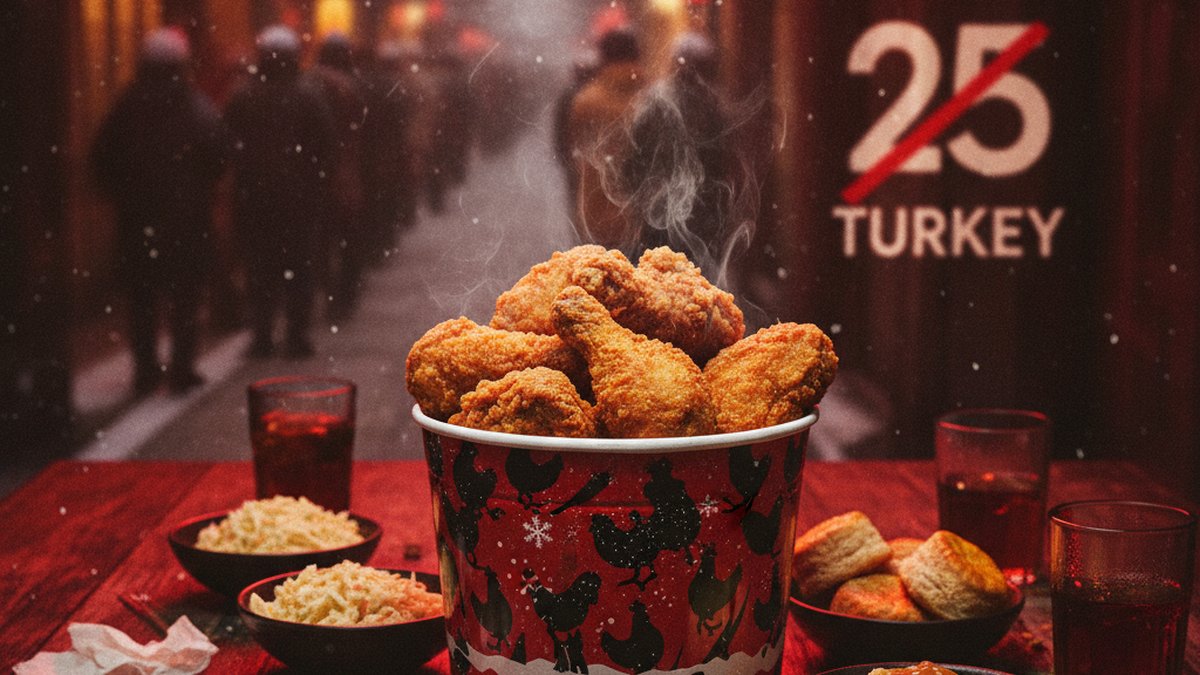
The vehicle for the tradition is the Christmas party barrel — a bundled festive box that goes far beyond a standard bucket. A typical barrel pairs fried chicken with sides and a Christmas cake or dessert, dressed in seasonal packaging; premium versions over the years have added whole roast chicken and gratins. It is designed as a complete, collect-and-serve Christmas dinner for a family — closer in spirit to a South African sharing meal than to an ordinary takeaway order.
The barrel did something subtle: it turned a fast-food purchase into an occasion product. You do not grab a party barrel on a whim; you plan for it, book it, and collect it on the day, the way other cultures collect a turkey or a gammon. Pricing reflects that occasion status too — a barrel costs several times an ordinary meal, and nobody minds, because it is buying Christmas, not just dinner.
Ordered weeks ahead, queued for on the day
Demand long ago outgrew walk-in capacity. KFC Japan opens Christmas reservations in early November each year, and regulars book their barrels weeks in advance — a pre-order is the only real guarantee of chicken on 24 or 25 December, and the earliest slots are prized. Those who chance it join queues that wrap around blocks, and stores routinely sell out. Staff describe the days around Christmas Eve as the busiest of the entire year, with all hands frying from before dawn.
The tradition in numbers (all approximate)
- Campaign launched: 1974, four years after Japan's first KFC opened in 1970.
- Peak period: roughly 20-25 December, with Christmas Eve the single biggest day.
- Sales scale: daily takings during the peak are reported at several times — up to roughly five to ten times — a normal day's.
- Booking window: party barrel reservations open from early November.
The scale is remarkable for what is, everywhere else, an ordinary trading week. The Christmas stretch is widely reported as KFC Japan's biggest sales event of the year by a wide margin, with millions of families taking part annually — figures vary by source, which is why we keep them approximate, but every account agrees on the essential point: nothing else in the KFC world compares. For context, South Africa's closest equivalent crunch is an ordinary festive-season weekend — meaningful, but nowhere near a single day carrying a measurable share of the year's turnover.
Why it stuck for fifty years
Marketing campaigns fade; this one became culture. A few forces explain it. First, the vacuum: only a small fraction of Japan is Christian, so Christmas arrived as a secular, commercial celebration — romantic dinners, illuminations, gifts — with no religious meal attached. A ready-made feast slotted straight in. Second, practicality: Japanese home kitchens rarely have ovens large enough to roast a bird, so collect-and-serve fried chicken beats home roasting on pure logistics. Third, consistency: KFC Japan has run the same message every December for five decades, until children who ate party barrels in the 1970s were buying them for their own grandchildren.
KFC did not interrupt a Japanese tradition — it became one, by showing up every single December for fifty years.
There is also the ritual itself. Pre-ordering, collecting on the day, sharing a branded barrel at a family table — the friction is the point. It marks the meal as special, the way braai-day rituals do here. The barrel also slotted neatly into an existing Japanese Christmas custom: the Christmas cake, a sponge-and-strawberries dessert that families already bought for the day. Chicken plus cake completed the menu, and KFC obligingly bundled both into its party barrels. Competing chains and supermarkets now sell mountains of their own Christmas fried chicken — the surest sign a campaign has become culture is that everyone else copies it — yet the original brand still owns the day.
Japan as a KFC market today
Christmas built KFC Japan into the chain's third-biggest market on earth: roughly 1,130 stores, behind only China's ~10,300 and the United States' ~3,800, as our global store-count guide lays out. Japanese KFC positions itself as a premium treat rather than cheap fuel, yet in world terms its pricing is moderate: a Zinger costs about ¥490 — roughly $3.30 on our KFC Index, almost exactly what South Africans pay in dollar terms for their R60.90 Zinger. Japan's menu adventurism — seasonal shrimp items included — gets its due in our world menu tour.
Building the SA equivalent
South Africa has no pre-order Christmas barrel — but the local menu can assemble a very respectable festive spread, and at bottom-tier world prices. Here is what a Japanese-style family feast costs in rand today:
| SA option | What you get | Price | Feeds (approx.) |
|---|---|---|---|
| All-in-One Feast | Chicken plus sides in one box | R197.90 | 3-4 people |
| 9 Piece Bucket | 9 pieces Original Recipe | R179.90 | 3-4 people |
| 15 Piece Bucket | 15 pieces Original Recipe | R281.90 | 5-6 people |
| Family Treat 10pc | 10 pieces plus family sides | R317.90 | 4-5 people |
| 21 Piece Bucket | 21 pieces Original Recipe | R359.90 | 7-8 people |
A 21 Piece Bucket at R359.90 feeds a Christmas-lunch crowd for well under R55 a head — the kind of arithmetic our bucket price guide exists for. No queue around the block required, though December trading days at SA stores get lively enough on their own.
The lesson in the barrel
Kentucky for Christmas is the best case study in fast-food history of a brand becoming a ritual: find an empty cultural slot, fill it with something families can share, and repeat for fifty years without blinking. Other markets have tried to bottle the same magic — Christmas promotions come and go across Asia and Europe every year — but none has reproduced the Japanese alignment of empty slot, practical product and five decades of patience. Japan queues for chicken every 24 December not because the chicken is different, but because the meaning is. South Africans, meanwhile, get the same chicken — at some of the lowest prices in the KFC world, as our world price ranking shows — every ordinary Tuesday, no reservation required.
Key Takeaways
- Japan's KFC Christmas tradition began with the 1974 'Kentucky for Christmas' marketing campaign — four years after Japan's first store opened in 1970.
- Families pre-order Christmas party barrels weeks in advance; walk-in customers on 24-25 December face long queues or sold-out stores.
- The Christmas period is KFC Japan's biggest sales event of the year by a wide margin, with daily sales reported at several times normal levels.
- It stuck because Japan had no established Christmas dinner: Christmas is a secular, festive occasion there, and KFC filled the vacuum with a ready-made ritual.
- Japan is now KFC's third-biggest market with roughly 1,130 stores, and its Zinger costs about the same in dollars as South Africa's R60.90.
Frequently Asked Questions
Why does Japan eat KFC at Christmas?
A 1974 KFC Japan campaign, 'Kentucky for Christmas', marketed fried chicken as the festive meal in a country with no existing Christmas dinner tradition. Japan celebrates Christmas as a secular occasion, and the ritual stuck.
Do Japanese customers really order KFC weeks in advance?
Yes. Christmas party barrel reservations open in early November, and pre-ordering is effectively required — walk-in customers on 24-25 December face long queues and frequent sell-outs.
What is in a KFC Japan Christmas party barrel?
A festive bundle of fried chicken with sides and typically a Christmas cake or dessert, in seasonal packaging. Premium versions have included whole roast chicken and gratins.
How big is KFC in Japan?
Japan is KFC's third-biggest market, with roughly 1,130 stores; the first opened in 1970. A Japanese Zinger costs about 490 yen — roughly $3.30, close to South Africa's R60.90 in dollar terms.
Sources & Further Reading
- KFC in Japan — Wikipedia
- KFC — Wikipedia
- Yum! Brands — Yum! Brands

The Menu Desk is kfcmenuprice.co.za's research team. We track KFC South Africa prices monthly across stores, the KFC app and delivery platforms, and maintain the KFC Index comparing prices in 45+ countries. This site is an independent fan resource and is not affiliated with KFC Corporation or Yum! Brands.