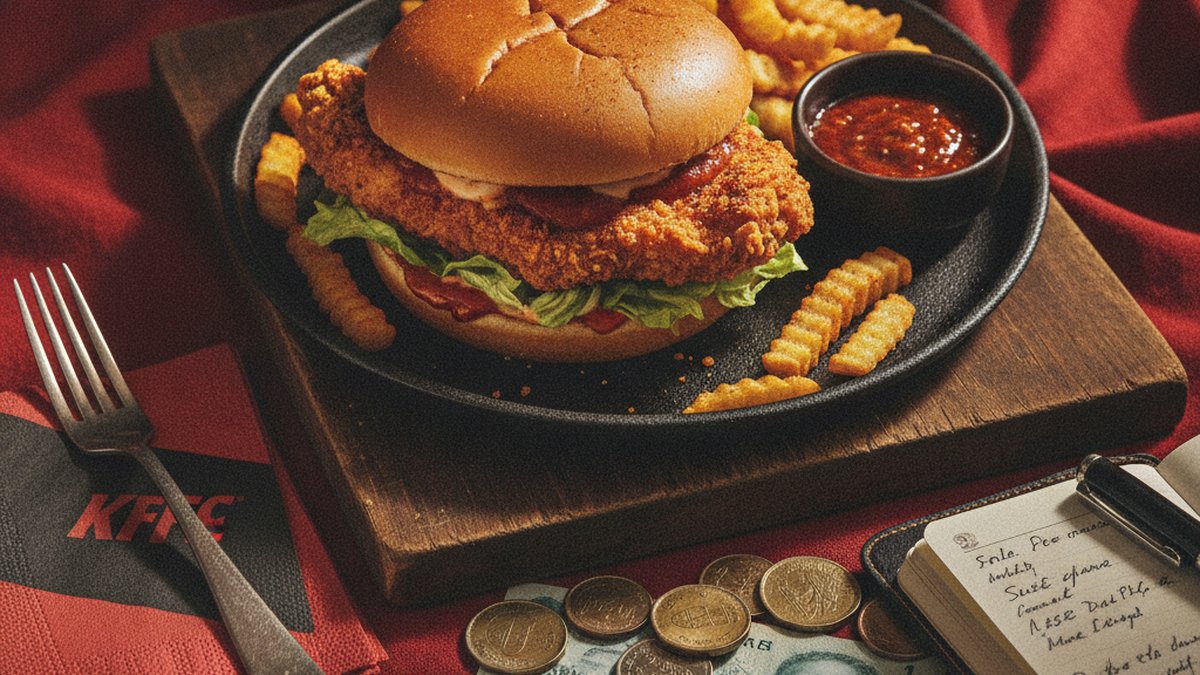
One burger, one price list, more than 45 countries. The KFC Index takes the a-la-carte Zinger Burger — R60.90 in South Africa — and asks what the same order costs everywhere from Mumbai to Zurich. This is exactly how we build it, and exactly where its limits are.
Why compare countries with a chicken burger?
The idea is borrowed, openly, from The Economist's famous Big Mac Index, which has used the price of a McDonald's Big Mac since 1986 as a light-hearted way to compare currencies. The logic is simple: if a product is made to a near-identical specification in dozens of countries, then the price differences between those countries tell you something about local costs, local wages and whether a currency is cheap or expensive in real terms.
A standardised fast-food item is unusually good for this. The recipe is controlled by one brand, the ingredients are broadly the same, and the product is sold to ordinary people in ordinary shopping centres — not to tourists at airport prices. Economists call this style of comparison "burgernomics", and it works because the burger itself barely changes while everything around it — rent, labour, tax, currency — does.
South Africa has a McDonald's presence, but KFC is by far the bigger chain here, with roughly 960 stores against a few hundred golden arches. For a South African site tracking KFC prices, a KFC-based index is simply the more natural instrument.
Why the Zinger Burger specifically?
Because it is the closest thing KFC has to a global constant. The Zinger — a spicy crispy chicken fillet with mayo and lettuce on a bun — is sold in nearly every KFC market on earth, from Pakistan to Poland, usually under exactly the same name. Buckets vary wildly in piece counts and sides; combos bundle different drinks and chips portions; local specials come and go. The a-la-carte Zinger is one fillet, one bun, one price.
There is one notable exception: the United States, KFC's birthplace, where the Zinger has come and gone from menus over the years. For the US we price the closest equivalent — the crispy Classic Chicken Sandwich — and say so in the country notes. A handful of other markets get the same treatment where the exact Zinger name is not used.
We also insist on the burger alone, not the meal. Combo composition differs too much between countries to compare fairly — some bundle a 300ml drink, others a 500ml one, and chips portions are anything but standard. If you want to see how the Zinger fits into the local line-up at home, our KFC burger price list has every South African burger side by side.
How we collect prices and convert to dollars
Prices are compiled from official KFC market menus and delivery-platform listings in each country, in the local currency. We then convert every price to US dollars at prevailing exchange rates. The dollar is the yardstick simply because it is the world's reference currency — it lets a reader put Indonesia's rupiah price and Switzerland's franc price on the same axis.
Two honesty notes belong here. First, every figure is an estimate: fast-food prices change frequently, differ slightly between stores in the same country, and delivery-platform prices often carry a markup over counter prices. Second, exchange rates move daily, so a country's dollar price can drift even when its local menu has not changed at all. We refresh the dataset periodically rather than pretending to real-time precision.
The index at a glance
- Product: a-la-carte Zinger Burger, or the closest crispy chicken fillet burger where the Zinger is not sold.
- Coverage: 45+ countries across Africa, the Americas, Europe, the Middle East and Asia-Pacific.
- Currency: local menu price, converted to US dollars at prevailing rates.
- Status: all figures are approximate and periodically refreshed.
What the numbers actually show
Read as a purchasing-power snapshot, the index is genuinely revealing. Here is a sample of the spread, anchored to South Africa's R60.90 Zinger:
| Country | Local price (approx.) | USD (approx.) | Vs South Africa |
|---|---|---|---|
| India | Rs 199 | $2.35 | About 29% cheaper |
| China | CNY 21 | $2.95 | About 10% cheaper |
| South Africa | R60.90 | $3.29 | Baseline |
| United States | $5.99 | $5.99 | Nearly double |
| United Kingdom | GBP 5.49 | $7.00 | More than double |
| Switzerland | CHF 10.90 | $12.30 | Almost four times |
The pattern is the same one the Big Mac Index has shown for decades: identical products cost far more in rich countries. A Swiss Zinger at roughly $12.30 is not four times more chicken than a South African one — it is the same burger carrying Swiss wages, Swiss rent and Swiss taxes. Conversely, when a country's Zinger looks very cheap in dollars, that often suggests its currency is undervalued against the dollar, or that its labour and property costs are simply much lower.
A worked example: the burger-implied exchange rate
Burgernomics has one neat party trick. Divide South Africa's R60.90 by the American price of about $5.99 and you get a burger-implied exchange rate of roughly R10 to the dollar. The actual market rate is far weaker — in the region of R18.50 to the dollar at the rates behind this dataset. On pure chicken-burger logic, then, the rand looks substantially undervalued against the dollar: a South African earning rands pays far less real-world value for the same lunch than an American earning dollars. That is the purchasing-power story in one division sum — and it is the reason economists keep coming back to burger indices even while smiling at them.
For South Africans the takeaway is oddly comforting: measured in chicken-burger terms, the rand buys a lot. Our full ranked walkthrough — the cheapest and most expensive KFC countries — turns the table into a story.
The limitations, stated plainly
No burger index is an economics textbook, and ours has the same caveats the Big Mac version does — plus a few of its own.
Portion sizes and recipes drift
A Zinger fillet in Jakarta is not weighed against a Zinger fillet in Johannesburg. Fillet size, bun size and sauce quantities vary between markets, so a cheaper burger is sometimes also a slightly smaller one.
Taxes are baked in differently
Some countries display prices with VAT or sales tax included, others add it at the till; VAT rates themselves range from zero to more than 20%. We use the price a customer actually pays, but tax differences mean part of the gap between countries is fiscal, not culinary.
Franchising means local pricing power
KFC is overwhelmingly a franchise business. Local operators set their own prices within brand guidelines, respond to their own costs, and run their own promotions. Two neighbouring countries with similar economies can price the same burger quite differently simply because different companies run them.
Exchange rates wobble
A 10% move in the rand against the dollar changes South Africa's index position without a single till price changing. That is why we describe every dollar figure as approximate, and why rankings should be read in tiers rather than obsessed over position by position.
How to use the index well
Treat it as a lens, not a laboratory. It is excellent for the big questions: which countries are structurally cheap or expensive, how far the rand stretches, and how a market of KFC's scale — roughly 30,000+ stores in 145+ countries, as we unpack in our global store-count guide — prices one product for very different customers. It is weak on fine distinctions: a few cents of dollar difference between two countries is noise, not signal.
The full, sortable table lives at the KFC Index, with every country's local price, dollar price and notes. And if the index leaves you curious about the stores behind the numbers, our world directory maps where KFC actually operates, market by market.
Key Takeaways
- The KFC Index compares the price of an a-la-carte Zinger Burger (or its closest equivalent) across more than 45 countries.
- All local prices are converted to US dollars at prevailing exchange rates, so every market can be read on one scale.
- South Africa's Zinger costs R60.90 — roughly $3.29 — which puts it among the cheapest markets we track.
- Like the Big Mac Index, it is a rough purchasing-power snapshot, not a precise economic instrument.
- Portion sizes, taxes, franchising models and exchange-rate swings all limit how literally the numbers should be read.
Frequently Asked Questions
Why is the Zinger Burger the comparison product?
It is sold in nearly every KFC market worldwide to a near-identical recipe, usually under the same name. That consistency makes it the cleanest single product for comparing KFC prices between countries.
Is the KFC Index the same as the Big Mac Index?
It borrows the same idea — pricing one standardised fast-food item across countries as a rough purchasing-power comparison. Ours uses KFC's Zinger because KFC is South Africa's dominant chain, with roughly 960 stores.
How accurate are the prices in the index?
They are estimates compiled from official menus and delivery listings, converted to US dollars at prevailing rates. Menu prices and exchange rates both move, so read the figures as approximate and the rankings in tiers.
What does the index say about South Africa?
SA's Zinger costs R60.90, roughly $3.29 — among the cheapest markets tracked. Measured in chicken-burger terms, the rand has strong purchasing power compared with rich-country currencies.
Sources & Further Reading
- Big Mac Index — Wikipedia
- KFC — Wikipedia
- Yum! Brands — Yum! Brands

The Menu Desk is kfcmenuprice.co.za's research team. We track KFC South Africa prices monthly across stores, the KFC app and delivery platforms, and maintain the KFC Index comparing prices in 45+ countries. This site is an independent fan resource and is not affiliated with KFC Corporation or Yum! Brands.